From client brief to shot list in one afternoon
The afternoon after the kickoff call is one of the biggest levers in short-form production. Here is the AI-assisted pattern we use to close it.
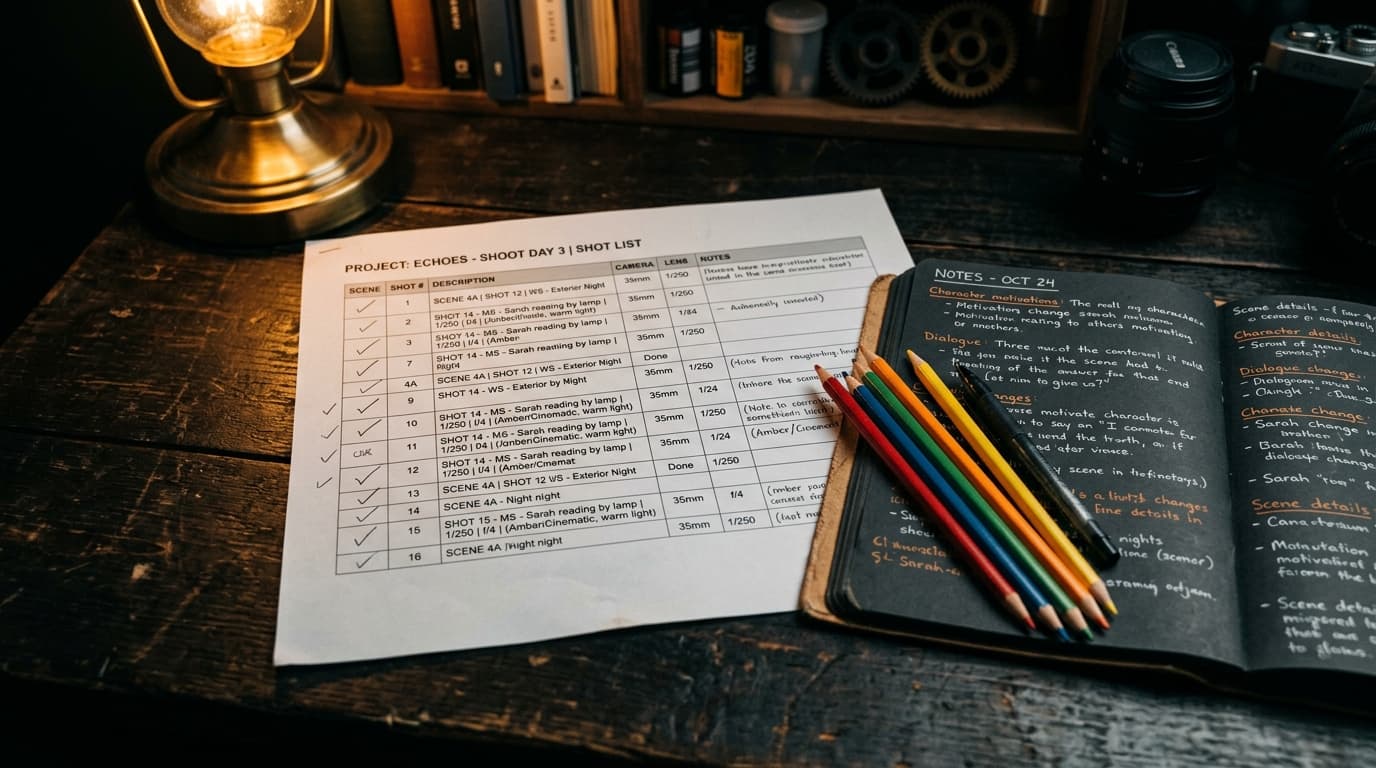
The gap between a five-paragraph client brief and a working shot list is where most production timelines quietly slip. The brief arrives looking decisive. By the time someone tries to shoot it, half the decisions turn out to be missing. The afternoon after the kickoff call is when that gap either gets closed or gets handed downstream — and downstream is always more expensive.
What a good shot list actually needs
A shot list is not just a set of frames. Before you can write one, resolve five things:
- Intent per scene. What is this moment doing for the story?
- Location and access. Where are we shooting, and who owns the space?
- Cast and wardrobe. How many people are in frame, and what are they wearing?
- Duration target. How long does this scene need to be in the final edit?
- Technical constraints. Lens availability, crew size, daylight, sound.
Most briefs cover one or two of these. A good shot list forces you to resolve all five before you point a camera at anything.
Where AI fits in the translation step
Given a structured brief, an AI assistant can reliably do the tedious middle layer:
- Expand "a scene at the client's office" into three concrete location variants with shot counts for each.
- Generate a default shot list for a two-character dialogue, ordered by coverage.
- Flag gaps: The brief mentions a product demo but does not specify the hero object.
- Produce a per-scene call sheet outline with rough duration estimates.
None of this replaces the producer's judgement. It speeds up the boring part of the afternoon, so the producer can spend time on the interesting part — the parts the brief is silently avoiding.
A working pattern
Our default afternoon flow, once a brief arrives:
- Feed the brief into the assistant with a fixed template (intent, location, cast, duration, constraints).
- Ask for a per-scene breakdown with shot counts and obvious gaps flagged.
- Walk the gaps with the producer and the writer, not the AI.
- Regenerate the shot list once the gaps are closed.
- Hand the result to the DP as a first draft, not a final.
The cycle is usually 90 minutes, and the output is a document the DP can actually read.
The discipline that keeps it working
- Keep the brief template stable across projects. The model learns to read it.
- Never let the assistant invent client information. Use placeholders and fill them by hand.
- Treat the generated shot list as a first draft. It is always slightly wrong in interesting ways.
- Version everything. The most valuable part of this workflow is being able to see how the brief changed between Monday and Friday.
Why it is worth doing
Production teams do not get more time. They get tighter loops. The afternoon after the kickoff call is one of the biggest levers in a short-form project, and it is still usually spent on copy-paste. Closing that loop with a small, tight AI workflow is the single clearest win we have seen so far — not because the AI is brilliant, but because the process around it is now explicit.